sales@synenzyme.com
+91 70435 76795

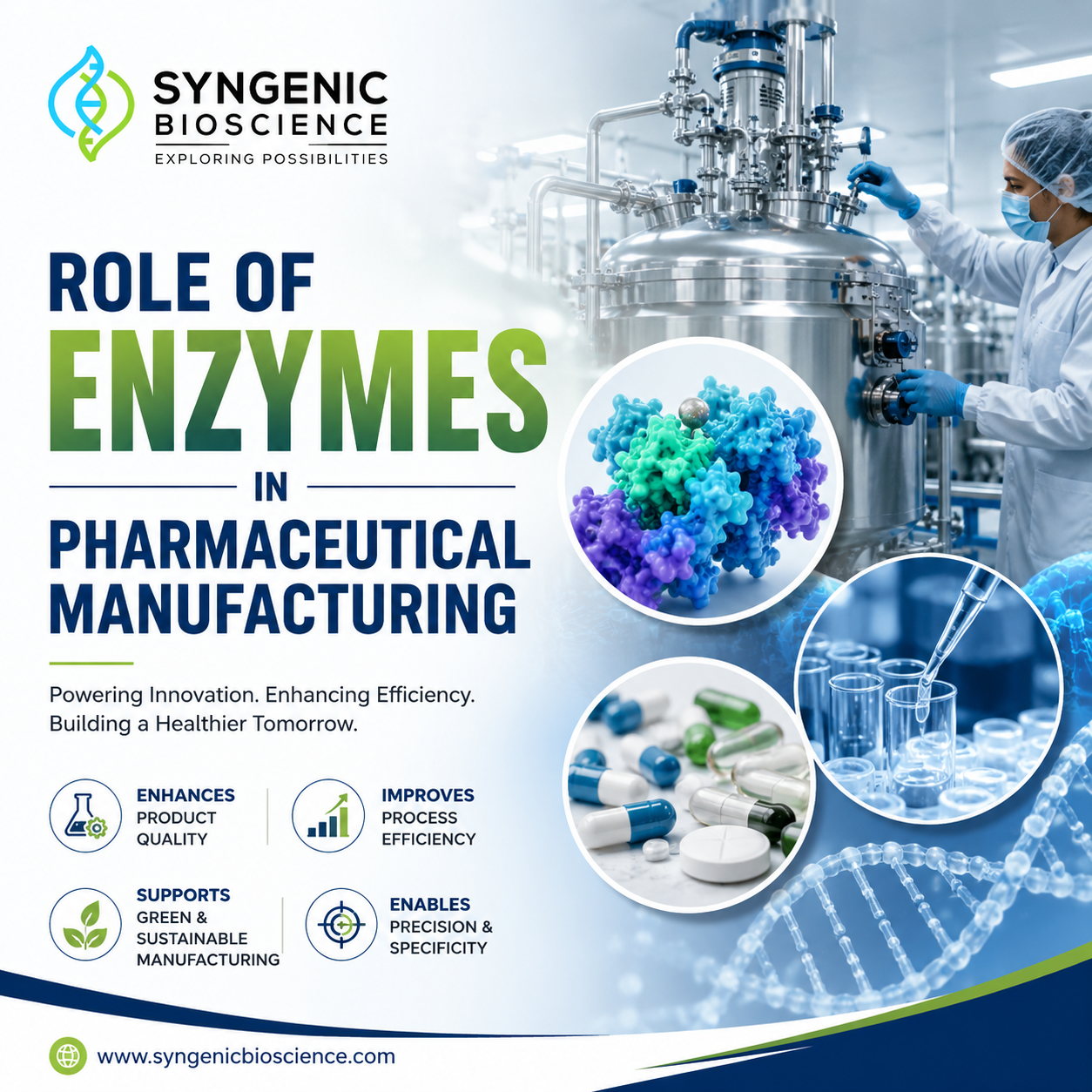
Enzymes have important role in the modern pharma manufacturing process. They help in producing precise, efficient and safe pharmaceutical products. With the right use of pharma enzymes, manufacturers can enhance quality, reduce cost & west and lower environmental effect. Role of enzymes in pharmaceutical manufacturing process have become more valuable in industry due to their growing presence from API synthesis to drug formulation and various quality control applications. They just improve efficiency and quality while keeping the pharmaceutical manufacturing process somewhat sustainable. Pharma enzymes work like biological catalysts and enhance controlled reaction, output and support environment making them one of the important component in advanced pharma manufacturing workflows.
Pharmaceutical enzymes are type of biological catalysts used in the formulation and development of pharmaceutical medicines. They accelerate biochemical reactions to make drugs more effective and efficient. Pharma enzymes are generally derived from plant or animal sources widely used in the API synthesis and drug formulation development. Due to their importance and effective role, they become essential part of modern pharmaceutical manufacturing process.
Imagine a lock and key. Traditional chemistry brings things together very hot. Enzymes, however, bend molecules into shape at room temperature.
They are the foundation of our faith. They are used to make the pills we swallow and at times, they are the medicine itself.
Reactions that used to take ten steps now take two. It simply saves a tremendous amount of time.
They’re extremely discriminating. Out of nowhere, these systems filter junk while what remains turns into clean stuff your body actually uses. Purity jumps when the junk vanishes mid-process.
You do not need heavy metals or 500-degree heat anymore. Scaling up biology is arguably much cheaper in the long run.
This is perhaps the biggest win. Pharmaceutical enzyme applications cut toxic waste drastically by replacing harsh solvents with simple water-based reactions.
Researchers use them to see how compounds break down in the body before human trials even start. It provides a massive head start.
The API is what actually cures you. Industrial enzymes for pharmaceuticals piece these complex molecules together flawlessly.
Using biology to trigger reactions is fast becoming the gold standard. You see this a lot with complex antibiotics.
If your body lacks a protein, doctors can just prescribe an enzyme to replace it. It goes straight to the source of the problem.
You might notice this in blood sugar monitors. They rely entirely on biological triggers to spot glucose levels accurately.
Proteolytic enzymes are used to remove complex proteins easily. Examples are Bromelain, Papain, Trypsin, Chymotrypsin and Serratiopeptidase.
A lot of people struggle with gut issues. Enzymes in the pharmaceutical industry include lab-made aids that help patients break down fats and carbs. Examples of digestive enzymes include Pancreatin, Pepsin and Fungal Diastase
These are highly engineered for rare genetic diseases. They replace a crucial biological gear that a patient might be missing.
Many enzymes are used to produce Digestive Health Supplements to improve your gut health. Those supplements are almost entirely enzyme applications in pharmaceuticals.
Bromelain in pharmaceuticals, derived from pineapples, naturally reduces swelling. Then there are serratiopeptidase uses in pharma. Originally from silkworms, it is now a potent pain treatment.
In manufacturing of Anti-cancer medications, enzymes are used for contribution in halting specific nutrients that cancer cells need for multiplications.
For rare conditions, replacing the exact missing protein is quite literally a lifesaver.
Enzymes in drug manufacturing overlap heavily with testing. Viral kits and cholesterol tests need these triggers to function.
Pharma enzymes help to increase manufacturing efficiency. Manufacturing companies get more usable medicine from your raw materials. There is simply less waste.
Biology rarely makes mistakes here. Every single batch looks identical to the last one.
Pharma enzyme manufacturing helps clean up the industry footprint. It is a much greener path forward.
Finding the right protein can completely bypass months of trial-and-error chemistry.
Cleaner drugs usually mean fewer side effects. The patient simply feels better overall.
Reliable Pharmaceutical enzyme supplier must have GMP certifications. They must possess quality certifications and work as per latest industrial norms.
Making something in a lab is easy. Producing tons for the global market is a completely different challenge. The real pharmaceutical enzyme manufacturer must have capacity to fulfill large requirements at global level.
A slight variation could ruin millions of dollars of medicine. Reliability is everything.
Sometimes you need a bespoke protein tweaked just for your specific formulation. The trusted pharmaceutical enzyme supplier has ability to provide custom enzyme solutions.
We contain wide range of enzymes along with extensive pharma enzyme portfolio for almost any type of your manufacturing project.
Our quality and R&D professionals have expertise to supervise and provide effective enzyme solutions to handle highly demanding factory conditions.
Syngenic being one of the leading pharmaceutical enzyme manufacturer in India, offers customized enzyme solutions for your project applications.
We know that chemistry and the rules—and we know exactly how biology gets to grips with complex production headaches. We combine our experience with expertise to offer best quality pharmaceutical enzyme.
What are pharmaceutical enzymes?
Found in natural settings, such proteins accelerate targeted reactions essential to medicine creation. During pharmaceutical manufacturing, they operate subtly – guiding intricate stages without notice.
How are enzymes used in drug manufacturing?
They replace harsh chemicals to build or cut down complex drug molecules safely.
What are the benefits of enzymes in pharmaceuticals?
Paying out a smaller amount typically speeds up progress, yet allows the environment to recover gently.
Which enzymes are commonly used in pharmaceutical manufacturing?
Bromelain, Papain, Trypsin, Chymotrypsin and Serratiopeptidase are used in the pharmaceutical manufacturing. These substances emerge across common scenarios.
Are pharmaceutical enzymes safe?
Yes, absolutely. They leave no toxic residue behind, making the final product very safe.
Biology is arguably beating traditional chemistry right now. The role of enzymes in pharmaceutical manufacturing is fundamentally rewriting how we make medicine. It removes the harshness of old methods and brings a kind of elegant precision to the factory floor. Where this leads next is anyone’s guess, but the foundation is incredibly solid.
