sales@synenzyme.com
+91 70435 76795


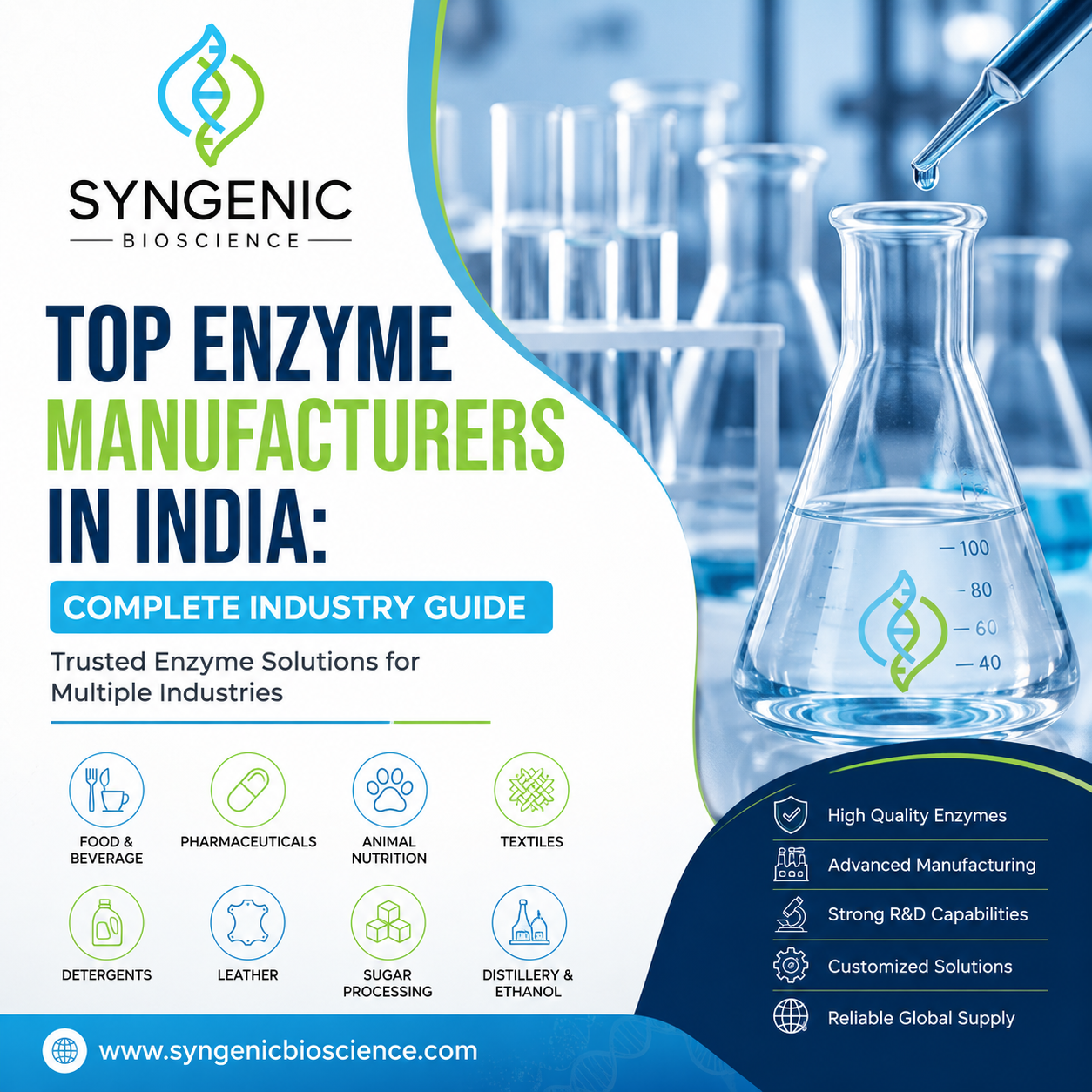
The production of enzymes has become an increasingly significant process in India because of the presence of the biotech industry in India, skilled manpower, increasing food and beverage sector, and increased need for enzymes in industrial applications. With growing demand across industries, choosing the right enzyme manufacturer is essential for quality, consistency, and reliable supply. Enzymes are applied in food processing, animal feed, textiles, detergent, pharmaceuticals, brewing, biofuel, and agriculture industries. There has been an increasing need for enzymes in various industries due to their efficiency in these processes. This guide explores the top enzyme manufacturers in India, their product capabilities, key applications, and factors to consider when selecting an enzyme manufacturing companies in India.
Enzymes are natural proteins that speed up specific chemical and biological reactions. Industrial enzymes are widely used in food processing, pharmaceuticals, animal nutrition, textiles, detergents, leather, and biotechnology. Their ability to perform specific reactions makes them valuable for improving efficiency, quality, and process consistency.
Industrial enzymes interact with specific substances called substrates and convert them into desired products. For example, amylase breaks down starch, while protease breaks down proteins. Each enzyme works best under specific conditions such as temperature and pH.
Industries use enzymes because they can improve production efficiency while reducing processing time, energy consumption, and chemical usage. Key benefits include:
This makes reliable industrial enzyme manufacturers in India important partners for businesses looking for consistent and application-specific enzyme solutions.
India is emerging as a major enzyme manufacturing hub due to its growing biotechnology sector, skilled workforce, advanced manufacturing capabilities, and competitive production costs. India also provides a number of benefits for the production of enzymes, such as proven fermentation capabilities, access to biotechnology expertise, and an important industrial consumer base. Increasing demand from food, pharmaceuticals, animal nutrition, textiles, and other industries is further driving the growth of enzyme manufacturers in India.
A wide range of enzymes made for particular industrial processes are produced by Indian enzyme manufacturers. Among the most common types are:
Amylase finds many uses in the preparation of food items, in brewing, baking, starch industries, and in the production of bioethanol. Amylase converts the starch to simpler forms of carbohydrate molecules.
Protease, having wide uses in the detergent industry, food industry, leather industry, animal nutrition, and as medicine, is an enzyme that catalyzes the breakdown of protein molecules.
Lipase applications include the use in the food industry, in production of dairy products, in animal feed, in detergents, and production of specialty chemicals. Lipase works with fats and oils.
Cellulase enzyme is particularly useful for the degradation of cellulose in the processes of textiles, pulp and paper manufacturing, animal feed, biofuel generation, and biomass processing.
Pectinase, a common enzyme used in the manufacture of fruit juices, wineries, food and textile industry, is an enzyme that breaks down pectin from plant material. Pectinase increases the extraction and clarification of the juice.
Xylan is among the chemicals that make up the plant cell wall and acts as a substrate for xylanase. Xylan is utilized in baking, animal feed, pulping, paper making, and biofuel production for better processing.
The food and dairy industry form the major consumer of enzymes lactase which facilitates the breakdown of lactose. The enzymes enable the production of lactose-free dairy products.
Animal feed normally requires phytase, which works for hydrolysis of phytic acid and mineral release, which includes phosphorus. It is significant for swine and poultry feed.
Glucoamylase is among the most common enzymes which take part in the production of bioethanol, beer production, and processing of starch. Glucoamylase converts molecules of starch into glucose.
Industrial enzymes are used across a wide range of industries because they can improve process efficiency, product quality, and production consistency. From pharmaceuticals and food processing to textiles, detergents, and ethanol production, different enzymes are selected according to specific processing requirements.
Pharma enzymes play an important role in pharmaceutical manufacturing and biotechnology. They are used in drug formulation, biocatalysis, diagnostics, and various biochemical processes where precise and controlled reactions are required.
Food grade enzymes help improve processing efficiency, texture, taste, clarity, and shelf life. Amylases, proteases, lipases, and pectinases are commonly used in food and beverage applications.
Feed enzymes help improve the digestion and utilization of nutrients in animal feed. Enzymes such as phytase, protease, and xylanase can support better nutrient availability and feed efficiency.
These enzymes are widely used in commercial and industrial baking to improve dough handling, bread volume, texture, and freshness. Bakery enzymes can also help maintain consistent quality during large-scale production.
In textile manufacturing, enzymes are used for processes such as desizing, biopolishing, and fabric finishing. Textile enzymes help achieve better fabric quality while reducing the need for harsh chemicals.
Detergent enzymes such as protease, lipase, amylase, and cellulase are important ingredients in modern detergents. They help break down protein, grease, starch, and other stains for more effective cleaning.
Leather manufacturers use enzymes during processes such as soaking, dehairing, bating, and finishing. Enzymatic treatment can improve leather quality and support more efficient processing.
Enzymes are used in sugar and starch processing to improve the conversion of raw materials into fermentable sugars. Sugar enzymes help increase process efficiency and improve the consistency of the final product.
Enzymes are essential in distillery and ethanol production for breaking down starch into fermentable sugars. Amylase and glucoamylase enzymes help improve fermentation efficiency and support higher ethanol yields.
Microbiology, fermentation, downstream processing, and quality control usually come together in producing an industrial enzyme.
Industrial enzyme manufacturers choose microorganisms that can effectively produce the necessary enzymes. Productivity, stability, or particular performance attributes can all be improved by strain development.
Appropriate nutrients and process parameters are used to produce specific microorganisms under regulated conditions. The microorganisms can manufacture the necessary enzymes on an industrial scale due to fermentation.
The fermentation broth and unwanted particles are removed from the enzyme following fermentation. A cleaner enzyme preparation can be achieved with the help of filtration and other recovery methods.
It is possible to concentrate and formulate the recovered enzyme with appropriate stabilising agents. This keeps the enzymes active during handling, storage, and transportation.
In accordance with the intended use and product specifications, enzyme manufacturers evaluate enzyme activity, purity, stability, microbiological characteristics, and other specifications.
The enzymes are stored in appropriate containers to protect them from contamination, heat, moisture, and other elements that could impair their activity. The product comes with suggested storage conditions.
Choosing the right enzyme manufacturer in India is important for consistent product quality and reliable supply. Consider these key factors:
India has a growing number of enzyme manufacturers serving industries such as pharmaceuticals, food processing, animal nutrition, textiles, detergents, and biotechnology. When comparing top enzyme manufacturers in India, businesses should look beyond product availability and consider manufacturing expertise, quality standards, technical support, and supply reliability.
A reliable enzyme manufacturer typically stands out through strong manufacturing infrastructure, a diverse product portfolio, and industry-specific expertise. Robust quality systems and R&D capabilities are also important for maintaining consistent enzyme performance and developing application-focused solutions. In addition, custom formulations, technical support, and dependable supply can make a significant difference for businesses with specialized requirements.
Syngenic Bioscience is an Indian enzyme manufacturer and supplier offering enzyme solutions for different industrial applications. The company provides multiple enzyme categories and focuses on quality, consistent manufacturing, and application-specific requirements.
With manufacturing capabilities supported by R&D and quality-focused processes, Syngenic Bioscience serves industries including food and beverages, pharmaceuticals, animal nutrition, textiles, detergents, and other industrial sectors. Its product portfolio makes it a potential partner for businesses looking for reliable enzyme solutions in India and international markets.
Understanding the difference helps businesses choose the right partner for their enzyme requirements:
For specialized or long-term requirements, working directly with an enzyme manufacturer in India can provide better technical support, customization, and supply consistency.
What is enzyme activity?
Ask the manufacturer for the activity of the required enzyme along with the method used to measure its activity. The enzyme activity plays an important role in the evaluation and dosage of products.
Is technical documentation available?
Request relevant technical documentation, including application instructions, safety information, certificates of analysis, and product specifications. Regulatory requirements and quality evaluation both benefit from documentation.
Can the product be customized?
Some activity levels, formulations, pH or temperature performance, or other features are necessary for certain applications. Verify if the manufacturer provides specialised enzyme solutions.
What is the minimum order quantity?
Standard items and customised formulas may have different minimum order quantities. Before placing an order, especially when assessing a new supplier, confirm the MOQ.
What are the storage requirements?
Ask about the best storage requirements, packaging, shelf life, humidity, and temperature. During the entire lifetime of use of the product, the activity of enzymes should be preserved while storing it.
Is technical application support available?
When choosing a dosage, improving process conditions, or troubleshooting performance, technical support might be helpful. A manufacturer who offers application support can assist clients in obtaining more reliable outcomes.
Who are the top enzyme manufacturers in India?
India has many enzyme manufacturers serving food, pharma, feed, textile, and other industries. Look for quality, product range, R&D, and reliable supply.
How are industrial enzymes manufactured?
Industrial enzymes are mainly produced through controlled fermentation, followed by extraction, purification, and formulation for specific applications.
What certifications should an enzyme manufacturer have?
Common certifications include ISO, GMP, HACCP, and FSSC 22000, depending on the product and industry requirements.
What is the difference between an enzyme manufacturer and supplier?
A manufacturer produces enzymes, while a supplier sources and provides them to customers. Manufacturers may also offer customization and technical support.
India’s extensive industrial sector along with its developing biotechnology sector is responsible for creating good prospects for the development of enzymes. The enzyme manufacturers give customised solutions for many different industries using enzymes including protease, amylase, phytase, and glucoamylase.
Businesses must not only base their decision on pricing alone when choosing an enzyme manufacturer in India; they must take into consideration other aspects such as enzyme activity, uniformity of product, documentation, customization capacity, MOQ, storage needs, and technical support. This would guarantee that the right enzyme for the specific process is selected and functions consistently.